
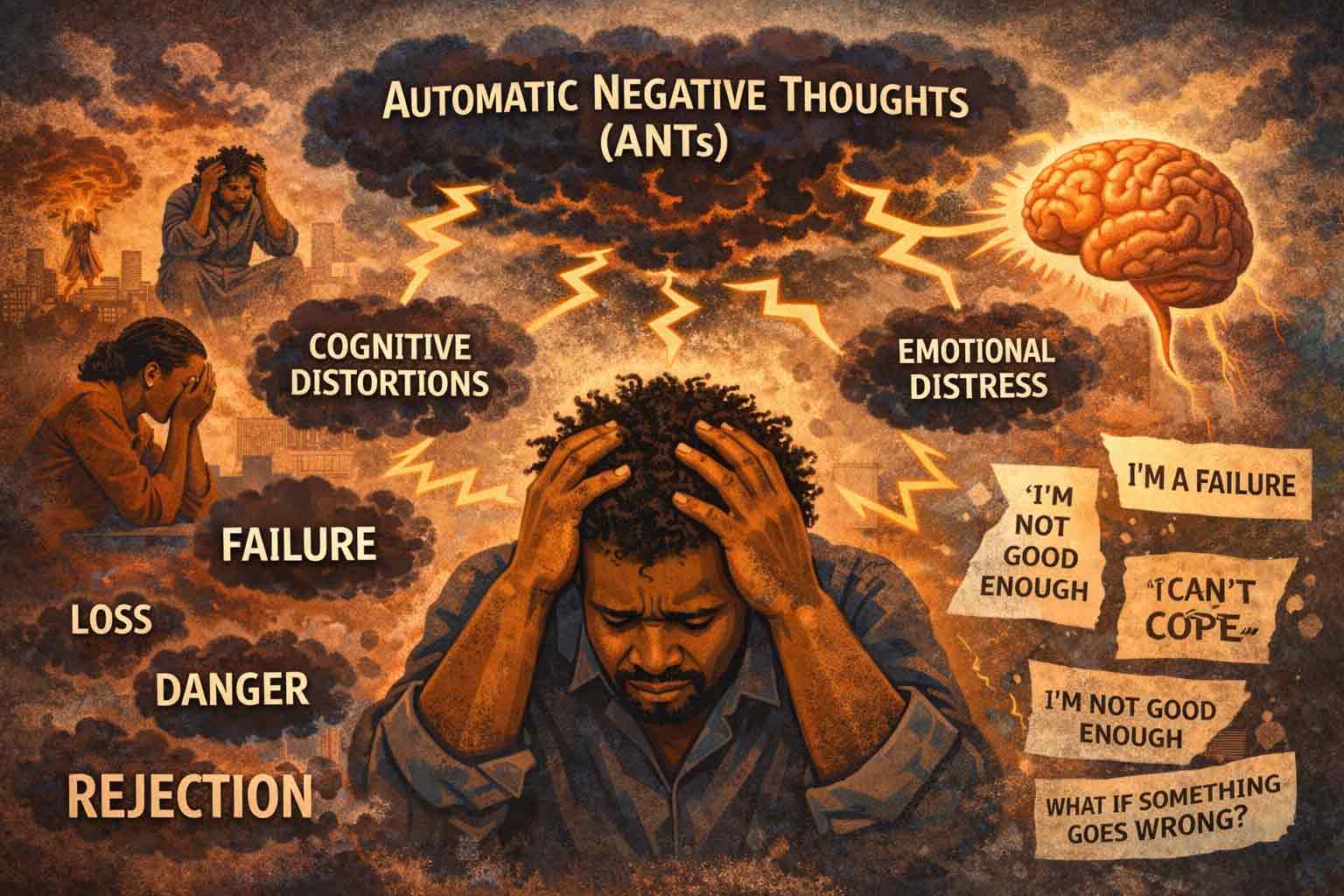
Definition
Negative Automatic Thoughts (NATs) are spontaneous, involuntary, and recurrent cognitive events characterized by negatively biased content—such as themes of failure, loss, danger, or rejection. Empirical evidence continues to demonstrate that these thoughts are strongly associated with psychological distress and are often accepted as valid without critical evaluation (Prasartpornsirichoke et al., 2025).
Cognitive Framework (Contemporary Evidence)
Recent empirical and theoretical developments confirm that NATs operate within a broader cognitive system involving schemas and belief structures that shape emotional and behavioral responses across disorders (Rupondo, 2025). Contemporary cognitive models emphasize the transdiagnostic role of automatic thoughts in linking cognition, emotion, and behavior.
Psychopathological Mechanisms
Current research highlights several mechanisms through which NATs contribute to mental disorders:
- Cognitive Biases and Distortions: Empirical studies show that maladaptive interpretations and biased information processing sustain emotional disorders (Iqbal, 2025).
- Emotional Dysregulation: NATs are significantly associated with depressive symptoms and reduced quality of life across populations (Prasartpornsirichoke et al., 2025).
- Behavioral Reinforcement Cycles: Avoidance and maladaptive coping behaviors reinforce negative thinking patterns and contribute to symptom persistence (Gkintoni et al., 2025).
- Neurocognitive Processes: Emerging evidence suggests that changes in negative thought patterns following CBT are associated with improvements in learning and emotional processing systems (Jin et al., 2025).
Disorder-Specific Manifestations
Recent empirical findings confirm that NATs present with distinct cognitive themes depending on the disorder:
- Depression: Persistent negative thoughts correlate strongly with symptom severity and treatment outcomes (Prasartpornsirichoke et al., 2025).
- Anxiety Disorders: Maladaptive threat interpretations and cognitive distortions remain central to anxiety pathology (Chand, 2023).
- Transdiagnostic Relevance: NATs are now widely recognized as a core mechanism across multiple psychological disorders, rather than being condition-specific phenomena (Gkintoni et al., 2025).
Clinical Implications
Recent empirical studies consistently demonstrate that reducing NATs is a key mechanism of change in Cognitive Behavioral Therapy (CBT). For instance, reductions in negative automatic thoughts have been directly linked to decreases in depressive symptoms and improvements in quality of life following CBT interventions (Prasartpornsirichoke et al., 2025). Digital and next-generation CBT approaches further enhance accessibility and effectiveness by targeting maladaptive cognitions through structured, personalized interventions (Gkintoni et al., 2025).
Conclusion
Recent empirical literature reinforces that NATs are central mechanisms in psychopathology. They not only distort perception and sustain emotional distress but also serve as measurable and modifiable treatment targets. Advances in CBT research including digital and process-based approaches continue to validate the critical role of NATs in both the development and treatment of mental disorders.
References (APA 7th Edition – Recent Empirical Sources Only)
Chand, S. P. (2023). Cognitive behavior therapy. In StatPearls. StatPearls Publishing.
Gkintoni, E., et al. (2025). Next-generation cognitive behavioral therapy: Digital tools, teletherapy, and personalized interventions. Medicina, *61*(3), 431.
Iqbal, A. (2025). Cognitive behavioral therapy: A contemporary approach to psychological disorders. ASSA Journal, *36*, 1–15.
Jin, Y., et al. (2025). Cognitive-behavioral therapy to normalize social learning in major depressive disorder: A clinical trial protocol. BMC Psychology.
Prasartpornsirichoke, J., et al. (2025). Effects of online cognitive behavioral therapy on depression, negative automatic thoughts, and quality of life. Frontiers in Psychiatry.
Rupondo, P. (2025). Beck’s Generic Cognitive Model and process-based therapy in transdiagnostic conditions. African Journal of Clinical Psychology.